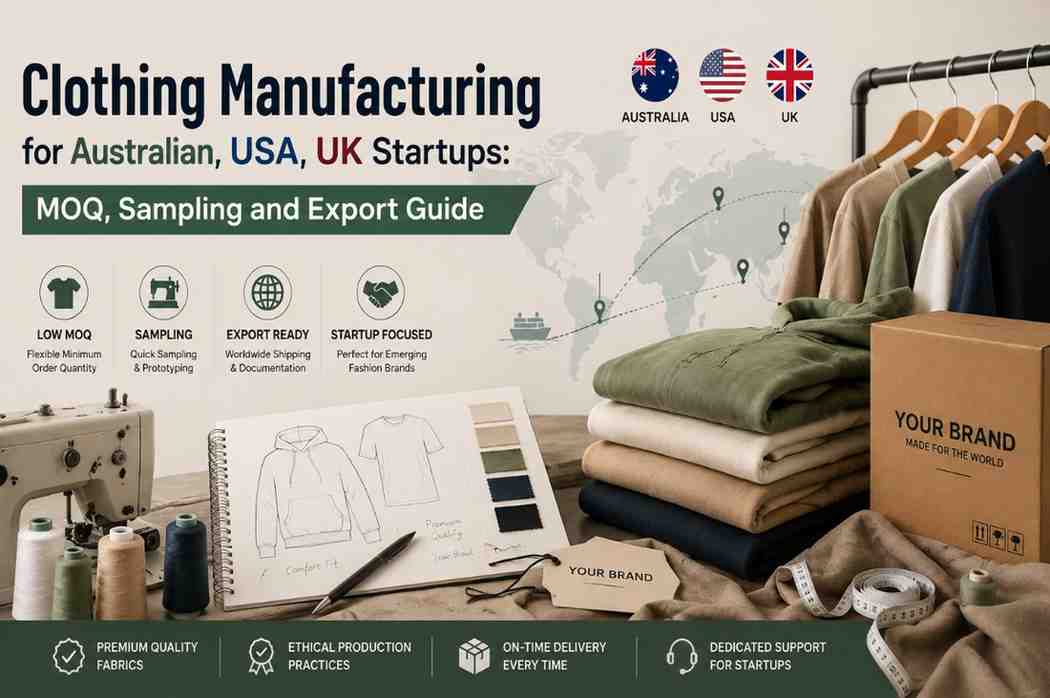

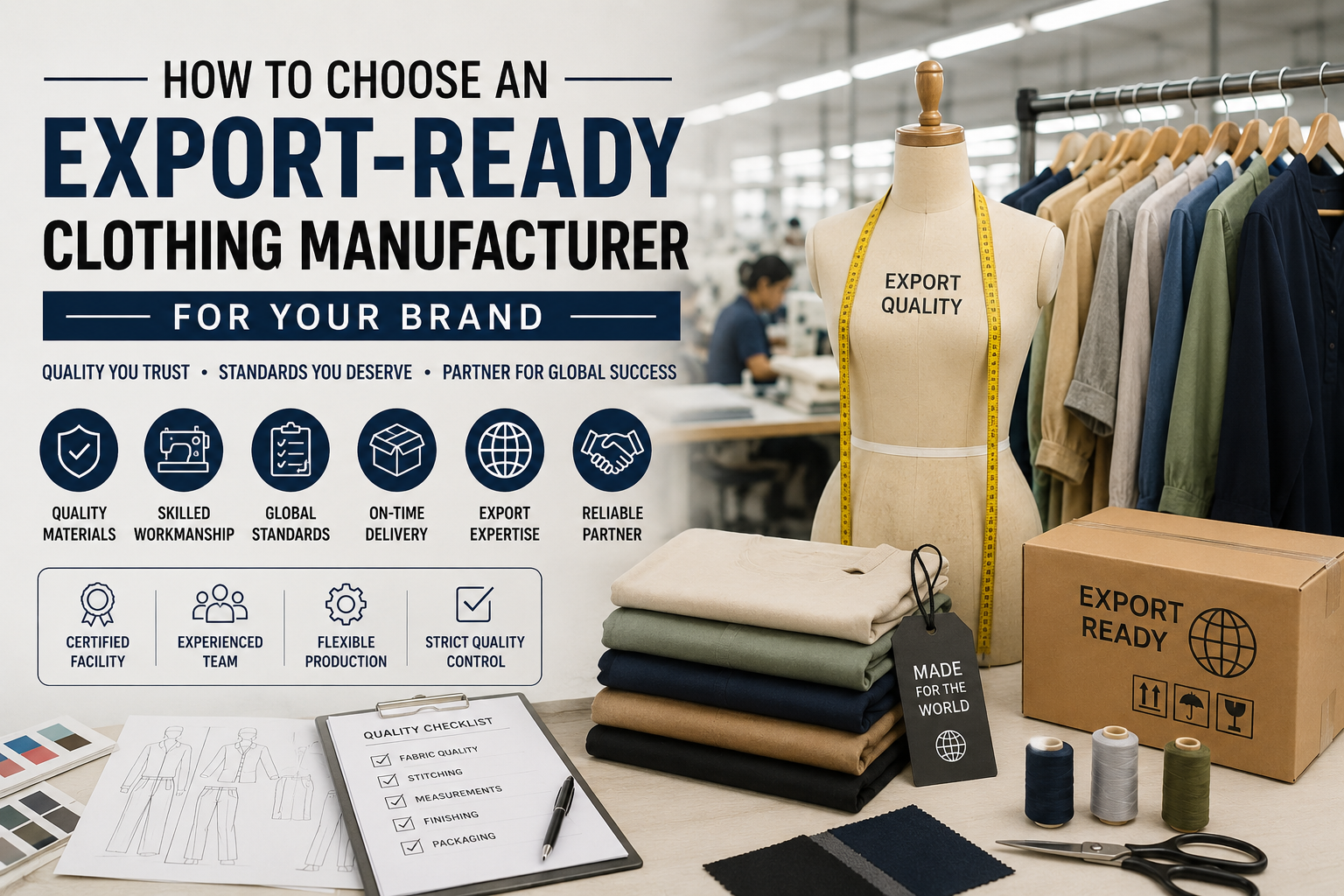
Launching a clothing brand is no longer limited to established fashion houses with large production facilities and significant budgets. Today, independent designers, ecommerce entrepreneurs, boutique labels, influencers, and growing fashion businesses can develop their own collections and sell them across international markets. However, turning a clothing concept into a commercially successful product requires more than finding a factory that can produce garments. The manufacturer you choose needs to understand your design requirements, quality expectations, production volumes, packaging needs, delivery timelines, and target-market requirements. For brands planning to sell internationally, choosing an export-ready clothing manufacturer becomes particularly important because the manufacturer needs to support a production process that is reliable from sampling through final shipment.
For startups searching for a Clothing Manufacturer for Startups UK, Clothing Manufacturers for Startups USA, or a Private Label Clothing Manufacturer UK, USA, the selection process should focus on long-term compatibility rather than simply the lowest quotation. A good manufacturing partner can help a new brand develop products consistently, manage production challenges, and scale as demand grows. Echo Earth can be positioned as a clothing manufacturing partner for brands seeking customisation, private-label production, OEM capabilities, and export-oriented manufacturing support. Whether you are building a small fashion label or preparing a larger collection for international distribution, the right manufacturing relationship can influence product quality, customer satisfaction, brand reputation, and future growth.
What Is an Export-Ready Clothing Manufacturer?
An export-ready clothing manufacturer is a production partner capable of manufacturing garments according to the requirements of brands selling in domestic or international markets.
Being export-ready involves more than producing clothing.
The manufacturer should have systems for sampling, production planning, quality control, packaging, documentation, and shipment coordination.
For international brands, communication and consistency are equally important.
A manufacturer may produce an excellent sample but still struggle with larger orders if it does not have sufficient production capacity or quality-control procedures.
Therefore, brands should evaluate the entire manufacturing process rather than judging a supplier based on a single sample.
Why Manufacturer Selection Matters for a Clothing Startup
A startup’s first collection can strongly influence how customers perceive the brand.
Poor stitching, inconsistent sizing, weak fabric quality, inaccurate colours, or unreliable delivery can lead to customer complaints and returns.
On the other hand, consistent manufacturing can help a new brand establish credibility.
The manufacturer becomes part of the brand’s operational foundation.
This is why entrepreneurs searching for a Startup Clothing Manufacturer UK, USA should think beyond the initial order.
Ask whether the manufacturer can support future collections, larger quantities, repeat orders, product variations, and changing customer requirements.
A manufacturer that can grow with your business may be more valuable than a supplier offering the cheapest first production run.
1. Start With Your Product Requirements
Before contacting manufacturers, define exactly what you want to produce.
Your product specification may include:
- Garment category
- Fabric composition
- Colours
- Sizes
- Construction details
- Embroidery or printing
- Labels
- Packaging
- Target quantity
- Expected retail market
The clearer your requirements are, the easier it becomes for manufacturers to provide accurate information.
If you approach a factory with only a general idea such as “I want to make premium clothing,” different manufacturers may interpret the project differently.
A detailed specification creates a stronger starting point.
2. Look for Relevant Manufacturing Experience
Not every clothing manufacturer specialises in every product category.
A factory may have extensive experience with T-shirts but limited experience with structured jackets.
Another may specialise in activewear rather than formal clothing.
The manufacturer should have experience relevant to your product.
For example, if your brand requires complex embroidery, ask about previous embroidery projects.
If you need heavyweight garments, discuss fabric handling and stitching requirements.
If your collection includes multiple garment categories, ask whether the manufacturer can manage the complete range.
Relevant experience can reduce production challenges.
3. Evaluate Sample Quality
Sampling is one of the most important stages of clothing manufacturing.
The sample allows you to evaluate the manufacturer’s understanding of your design before committing to bulk production.
Examine the sample carefully.
Look at stitching quality, seams, measurements, fabric feel, finishing, labels, buttons, zippers, prints, embroidery, and overall construction.
Do not focus only on appearance.
Try the garment on or have it evaluated according to the intended fit.
A sample that looks attractive but does not match the required measurements can create problems during production.
For an OEM Clothing Manufacturer USA, UK, the sampling process should be clear and structured.
4. Check Size and Measurement Accuracy
Sizing is particularly important for ecommerce fashion brands.
Customers expect the product to match the size chart provided online.
If actual measurements vary significantly between production batches, returns and customer dissatisfaction can increase.
Ask the manufacturer how measurements are controlled during production.
You should also approve a detailed measurement specification before bulk manufacturing begins.
For international markets, remember that sizing conventions can vary.
Your brand should establish its own size chart and communicate it clearly to customers.
5. Assess Fabric Quality
Fabric is one of the most noticeable aspects of a garment.
The right fabric affects appearance, comfort, durability, drape, fit, and customer perception.
When evaluating a manufacturer, ask about fabric sourcing and available materials.
If you already have a preferred supplier, determine whether the manufacturer can work with your supplied fabric.
If the manufacturer sources the fabric, request information about composition, weight, finish, and available colour options.
For premium collections, fabric consistency is especially important.
A fabric that changes noticeably between production runs can alter the appearance and performance of the garment.
6. Understand Private Label Manufacturing
Private label manufacturing allows a brand to sell garments under its own brand identity.
The manufacturer produces the clothing while the brand controls elements such as design, branding, labels, packaging, and customer-facing presentation.
A Private Label Clothing Manufacturer UK, USA can therefore be useful for entrepreneurs who want to establish their own fashion identity without building their own manufacturing facility.
Ask the manufacturer what private-label services are available.
These may include:
- Custom labels
- Neck labels
- Hang tags
- Packaging
- Custom colours
- Embroidery
- Printing
- Custom measurements
The exact services vary by manufacturer, so confirm them before production.
7. Consider Custom Clothing Manufacturing
If your collection uses original designs, you need a manufacturer that can translate your concepts into finished garments.
A Custom Clothing Manufacturer UK, USA should be able to work from specifications, technical drawings, reference samples, measurements, or other design information.
The communication process is important.
Your design team and manufacturing team need to understand the same specifications.
A professional manufacturing workflow may involve sample development, revisions, approval, grading, and bulk production.
Clear documentation helps reduce misunderstandings.
8. Understand OEM Clothing Manufacturing
OEM stands for Original Equipment Manufacturer.
In clothing production, an OEM arrangement generally involves manufacturing garments according to the brand’s specifications and requirements.
This can be particularly relevant for established brands with defined designs and technical requirements.
If you are considering an OEM Clothing Manufacturer USA, UK, ask about production capabilities, minimum order quantities, sample development, quality assurance, packaging, and delivery.
The manufacturer should be able to explain how it converts your approved specifications into production-ready garments.
9. Ask About Minimum Order Quantities
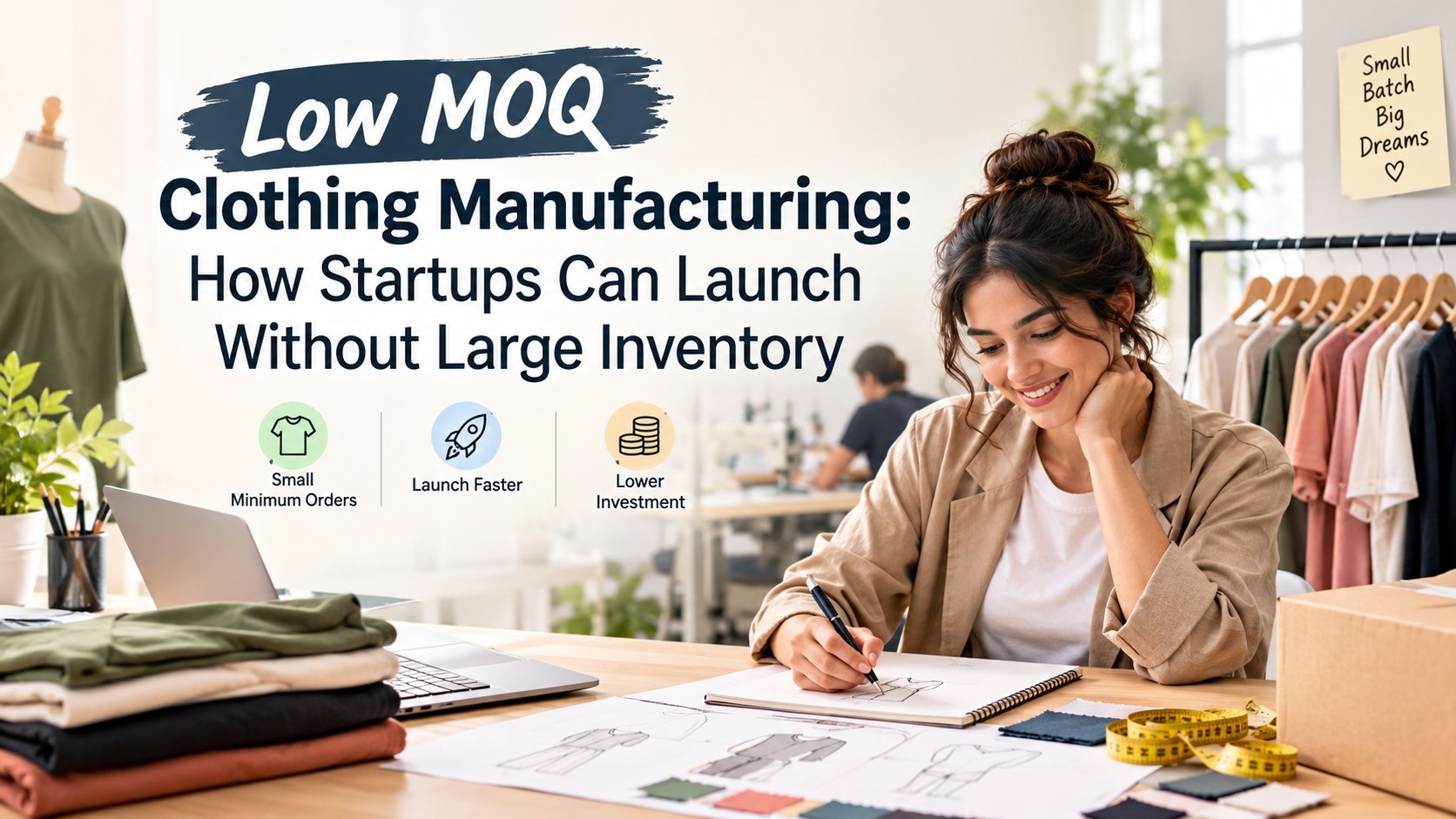
Minimum order quantity, commonly called MOQ, is an important consideration for startups.
A large MOQ can create significant financial pressure on a new brand.
You may need to invest heavily in inventory before knowing which products customers prefer.
A manufacturer willing to work with smaller initial quantities can be attractive for startups.
However, smaller production runs may have different pricing.
Instead of asking only for the lowest MOQ, compare the overall economics.
Consider unit cost, sampling cost, setup charges, packaging, shipping, and potential future reorder terms.
10. Evaluate Production Capacity
A manufacturer needs enough production capacity to meet your requirements.
However, capacity should not be considered only in terms of maximum output.
You should also understand how the manufacturer manages multiple orders.
A factory may have a large theoretical capacity but still struggle with your deadline during busy periods.
Ask about production scheduling and expected lead times.
If your brand experiences sudden demand growth, determine whether the manufacturer can increase production.
This is particularly important for startups that expect to scale through ecommerce or international distribution.
11. Examine Quality Control Procedures
Quality control should exist throughout the production process.
It should not happen only after the entire order has been completed.
A strong quality process can involve checking fabrics, measurements, stitching, colours, construction, finishing, labels, and packaging.
For large orders, brands may also want inspection procedures before shipment.
Ask the manufacturer what quality checks are performed.
You should also define acceptable standards before production begins.
A written quality specification creates a clearer reference for both parties.
12. Confirm Production Lead Times
Lead time affects inventory planning, product launches, marketing campaigns, and customer delivery.
Ask how long the manufacturer typically needs for:
- Sampling
- Sample revisions
- Material sourcing
- Production
- Finishing
- Packaging
- Shipment preparation
Do not plan your product launch around optimistic estimates.
Allow additional time for revisions, unexpected material delays, quality checks, and logistics.
A reliable manufacturer should communicate realistic timelines.
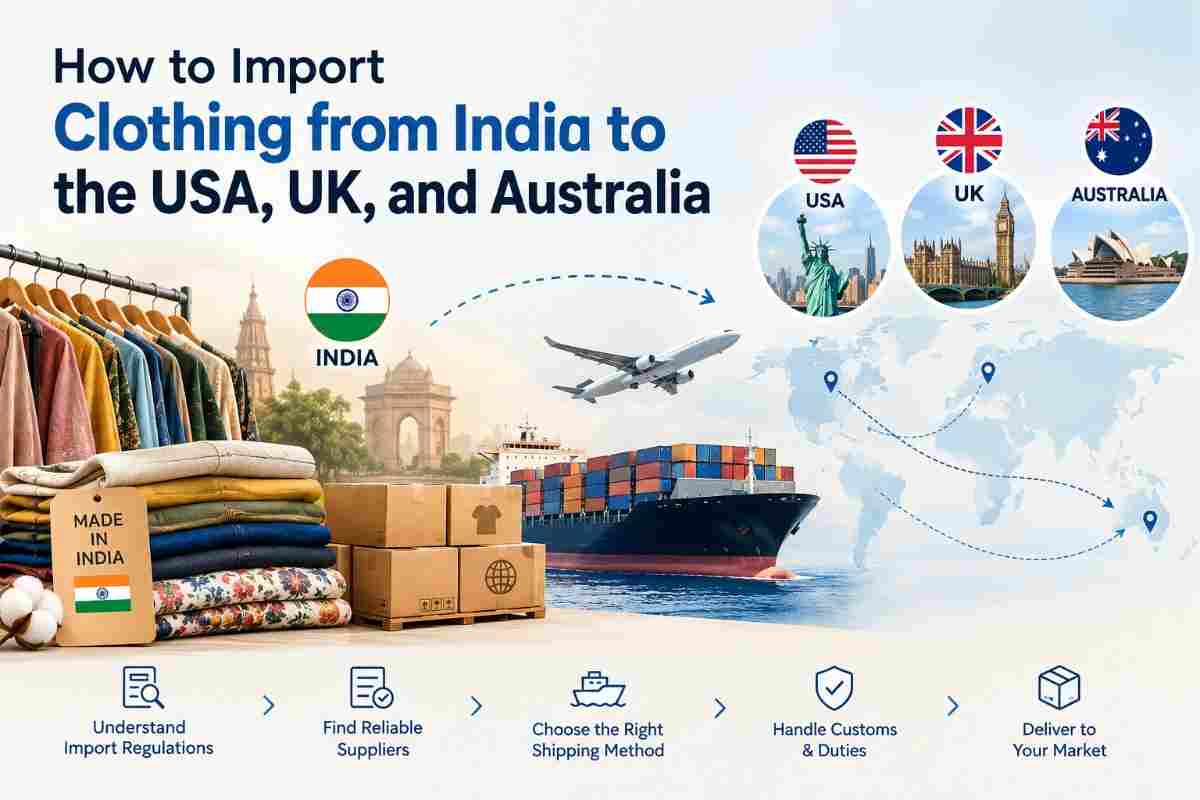
13. Consider Export and Shipping Experience
If your products will be sold internationally, export experience can simplify the manufacturing relationship.
Ask whether the manufacturer regularly works with international brands.
Discuss packaging, shipment preparation, commercial documentation, and coordination with logistics partners.
Your manufacturer may not be responsible for every part of international shipping, so clarify where its responsibilities begin and end.
A clearly defined process helps avoid confusion later.
For brands searching for Clothing Manufacturers for Startups USA, international production and delivery requirements should be considered before finalising the supplier.
14. Check Communication Quality
Communication problems can become expensive in clothing production.
A small misunderstanding about colour, measurements, stitching, fabric, or packaging can affect hundreds or thousands of garments.
Choose a manufacturer that communicates clearly.
You should be able to ask questions and receive specific answers.
Important decisions should ideally be documented.
Approved samples, technical specifications, measurement charts, fabric references, and production instructions should be maintained in an organised format.
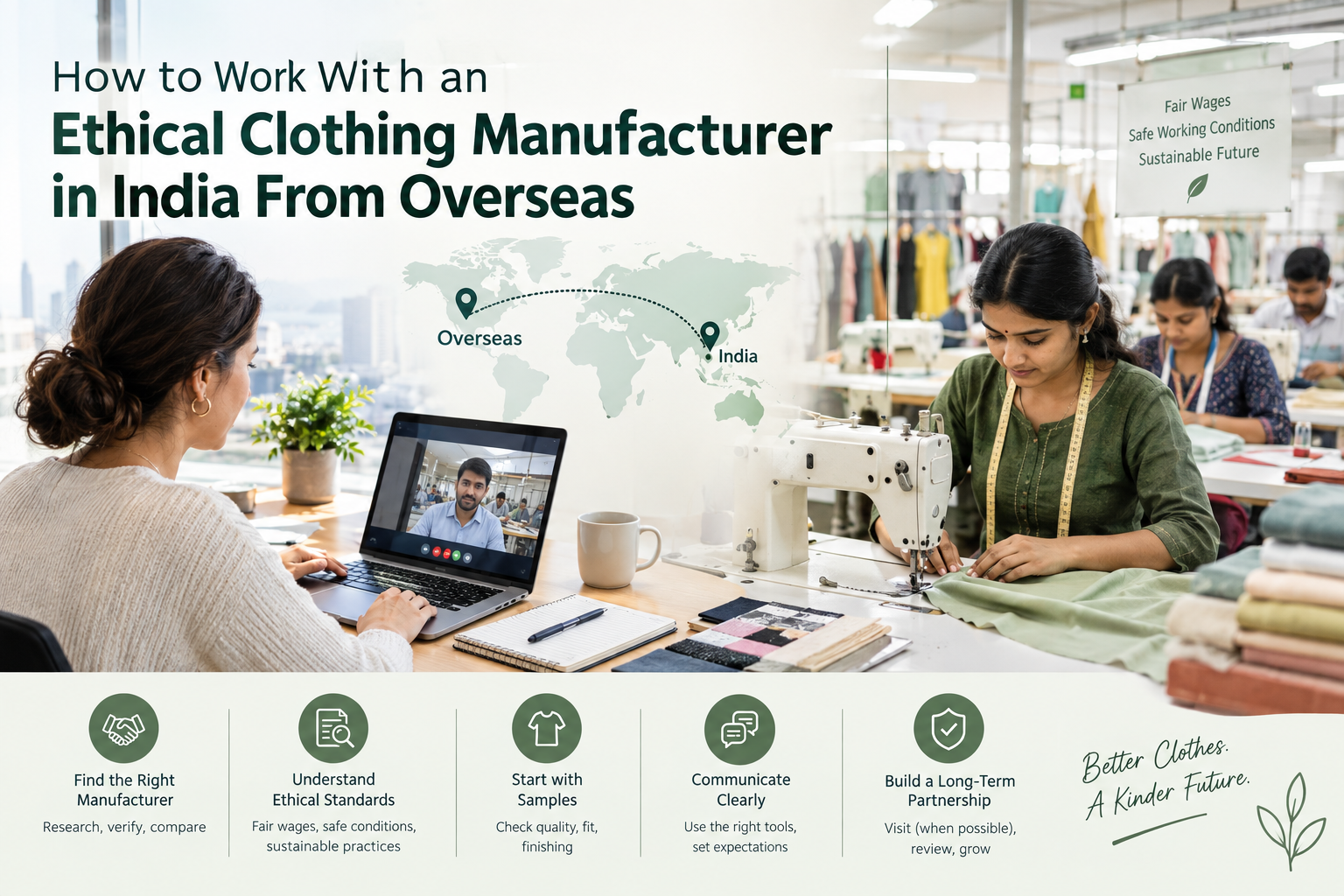
Good communication is particularly important when the brand and manufacturer operate in different countries.
15. Protect Your Designs and Brand Identity
Your clothing designs, logos, patterns, labels, and brand assets are valuable intellectual property.
Before sharing sensitive design information, understand how the manufacturer handles client information.
Where appropriate, businesses may use confidentiality agreements and clear contractual terms.
You should also establish ownership of designs, patterns, technical specifications, and brand assets.
This is particularly important for original designs that differentiate your brand from competitors.
16. Check Customisation Capabilities
Modern clothing brands often require more than standard manufacturing.
You may need:
- Custom labels
- Custom colours
- Embroidery
- Screen printing
- Special washing
- Unique trims
- Custom packaging
- Special finishes
Before choosing a manufacturer, determine whether these services are handled internally or through external suppliers.
If multiple vendors are involved, ask how quality and timelines are coordinated.
A manufacturer capable of managing more of the production process may simplify communication.
17. Think About Packaging
Packaging contributes to the customer’s first impression.
A premium garment can feel less premium if it arrives in poorly designed or damaged packaging.
For ecommerce brands, packaging also needs to protect the garment during transportation.
Discuss folding, tags, bags, boxes, tissue, labels, and other packaging requirements.
Your packaging should reflect your brand positioning.
A startup building a premium fashion identity may require different packaging from a basic wholesale clothing business.
18. Compare Pricing Properly
Price comparisons should always be based on equivalent specifications.
A manufacturer quoting a lower unit price may be using a different fabric, construction method, packaging specification, or production quantity.
When comparing suppliers, request a detailed quotation.
Look at:
- Sample charges
- Unit manufacturing cost
- Material costs
- Customisation charges
- Labels
- Packaging
- Setup charges
- Shipping
- Taxes or applicable fees
This gives you a more realistic understanding of your production cost.
19. Consider Scalability
A manufacturer that works well for 100 garments may not necessarily be the best choice for 10,000 garments.
Before committing to a long-term relationship, consider your growth plans.
If your startup becomes successful, can the manufacturer increase production?
Can it maintain the same quality?
Can it handle multiple styles simultaneously?
Can it support repeat orders?
These questions are important when choosing a Startup Clothing ManufacturerUK,USA.
A scalable supplier can become a valuable part of your long-term business infrastructure.
20. Review Previous Work
Ask the manufacturer whether it can provide examples of relevant work.
Look for products that are similar to what you intend to manufacture.
Pay attention to:
- Stitching
- Finishing
- Fabric quality
- Printing
- Embroidery
- Construction
- Packaging
Previous work can provide useful insight into manufacturing capabilities.
However, remember that the quality of your final product will also depend on your specifications, materials, quality standards, and approved samples.
Why Echo Earth Can Be Considered for Clothing Manufacturing
For emerging brands, finding a manufacturer that understands custom product requirements and brand development can be an important step.
Echo Earth can position its manufacturing offering around brands that require custom clothing production, private-label development, OEM manufacturing, and export-oriented support.
For startups, the objective should be to create a manufacturing relationship that can develop alongside the brand.
This means understanding the product concept, creating appropriate samples, maintaining production consistency, and supporting future collections.
Whether a brand is preparing its first capsule collection or developing a broader product range, manufacturing should be treated as a strategic part of the business rather than simply an outsourced production task.
Clothing Manufacturing for Startups in the UK and USA
Startups entering the UK and USA fashion markets need to think carefully about product positioning, sizing, pricing, branding, customer expectations, packaging, and fulfilment.
A Clothing Manufacturer for Startups UK should ideally understand that emerging brands may require smaller initial quantities and more flexible product development.
Similarly, Clothing Manufacturers for Startups USA may need to support brands with customised specifications and scalable production.
For a growing brand, the ideal manufacturing relationship is one where product development and production can evolve together.
Private Label Clothing for Growing Brands
Private label production can provide startups with control over their own brand identity.
Instead of selling generic garments under a supplier’s name, the business can develop a branded collection with its own labels, packaging, design language, and customer experience.
A Private Label Clothing Manufacturer UK, USA can therefore be valuable for fashion entrepreneurs who want to build a recognisable brand.
However, private-label success still depends on product quality.
A strong logo cannot compensate for poor construction or inconsistent sizing.
The product itself must deliver the quality promised by the brand.
Custom Clothing Manufacturing for Unique Designs
Custom manufacturing is particularly valuable when a brand wants to differentiate itself.
Rather than choosing an existing garment and adding a logo, the brand can specify details such as silhouette, fabric, colour, stitching, pockets, trims, labels, and finishing.
This provides greater creative control.
However, it also requires more communication and development.
The more customised the garment, the more important technical specifications and sampling become.
Brands should be prepared to review samples and provide precise feedback before approving bulk production.
How to Prepare Before Contacting a Manufacturer
Before approaching a manufacturer, prepare as much information as possible.
Create a product brief.
Include the garment type, desired fabric, colour references, size range, design details, estimated quantity, branding requirements, packaging requirements, target market, and expected timeline.
If possible, prepare technical drawings or tech packs.
This makes it easier for manufacturers to understand your requirements.
It also allows you to compare quotations more accurately.
Questions to Ask an Export-Ready Clothing Manufacturer
Before selecting a supplier, ask:
- What clothing categories do you specialise in?
- What is your minimum order quantity?
- Can you develop custom samples?
- Do you offer private-label production?
- Can you handle OEM requirements?
- What custom branding options are available?
- How is quality checked?
- What are typical production lead times?
- Can you support repeat and larger orders?
- How are international shipments handled?
- What information do you need before quoting?
- What happens if the production does not match the approved specifications?
Clear answers to these questions can help you identify whether the manufacturer is suitable for your business.
FAQs
1. What is an export-ready clothing manufacturer?
An export-ready clothing manufacturer is a supplier capable of producing garments for brands that operate across international markets, with appropriate systems for sampling, production, quality control, packaging, documentation, and shipment coordination.
2. How do I choose a Clothing Manufacturer for Startups UK?
Look for a manufacturer with relevant product experience, suitable MOQs, reliable sample development, quality-control procedures, clear communication, customisation capabilities, realistic lead times, and the ability to scale production as your business grows.
3. What should I look for in Clothing Manufacturers for Startups USA?
Evaluate manufacturing quality, product development capabilities, MOQ, custom branding, production capacity, communication, export experience, quality assurance, packaging, and long-term scalability.
4. What is a Private Label Clothing Manufacturer UK, USA?
A private-label clothing manufacturer produces garments that are sold under a brand’s own name and identity. Services may include custom labels, packaging, colours, embroidery, printing, and other branding options.
5. What is a Custom Clothing Manufacturer UK, USA?
A custom clothing manufacturer produces garments according to a brand’s specific design and technical requirements rather than simply supplying standard products.
Conclusion
Choosing an export-ready clothing manufacturer is one of the most important operational decisions a growing fashion brand can make. The right supplier should offer more than garment production. It should provide a reliable process for sampling, material selection, customisation, quality control, production management, packaging, and international order support.
For entrepreneurs searching for a Clothing Manufacturer for Startups UK or Clothing Manufacturers for Startups USA, the priority should be finding a supplier that understands the needs of emerging brands. Startups often need flexibility, manageable production quantities, strong communication, custom branding, and the ability to scale gradually. These requirements should be discussed before production begins.
Brands considering a Private Label Clothing Manufacturer UK, USA should also evaluate branding capabilities, including labels, tags, packaging, embroidery, printing, and other customisation options. Businesses looking for a Custom Clothing Manufacturer UK, USA should focus on sample development and technical accuracy, while companies requiring an OEM Clothing Manufacturer USA, UK should establish detailed production specifications and quality standards.
Echo Earth can be considered by brands looking for a manufacturing relationship focused on custom clothing development, private-label production, OEM requirements, and export-oriented manufacturing. The strongest manufacturing partnerships are built on clear communication, transparent specifications, consistent quality, realistic timelines, and a shared understanding of the brand’s long-term objectives.