

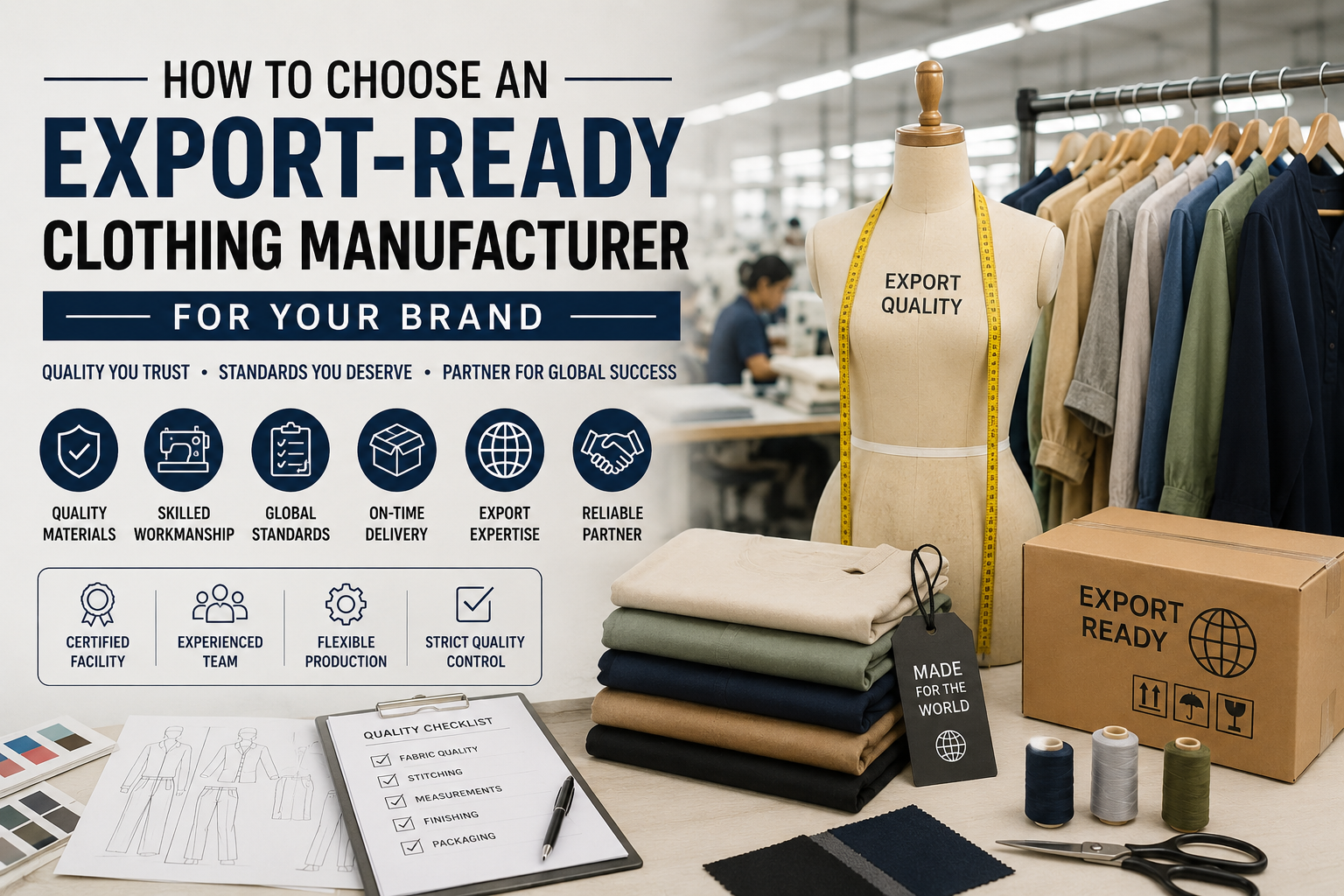
How to Choose an Export-Ready Clothing Manufacturer for Your Brand
Launching a clothing brand is no longer limited to established fashion houses with large production facilities and significant budgets. Today, independent designers, ecommerce entrepreneurs, boutique labels, influencers, and growing fashion businesses can develop their own collections and sell them across international markets. However, turning a clothing concept into a commercially successful product requires more than finding a factory that can produce garments. The manufacturer you choose needs to understand your design requirements, quality expectations, production volumes, packaging needs, delivery timelines, and target-market requirements. For brands planning to sell internationally, choosing an export-ready clothing manufacturer becomes particularly important because the manufacturer needs to support a production process that is reliable from sampling through final shipment. For startups searching for a Clothing Manufacturer for Startups UK, Clothing Manufacturers for Startups USA, or a Private Label Clothing Manufacturer UK, USA, the selection process should focus on long-term compatibility rather than simply the lowest quotation. A good manufacturing partner can help a new brand develop products consistently, manage production challenges, and scale as demand grows. Echo Earth can be positioned as a clothing manufacturing partner for brands seeking customisation, private-label production, OEM capabilities, and export-oriented manufacturing support. Whether you are building a small fashion label or preparing a larger collection for international distribution, the right manufacturing relationship can influence product quality, customer satisfaction, brand reputation, and future growth. What Is an Export-Ready Clothing Manufacturer? An export-ready clothing manufacturer is a production partner capable of manufacturing garments according to the requirements of brands selling in domestic or international markets. Being export-ready involves more than producing clothing. The manufacturer should have systems for sampling, production planning, quality control, packaging, documentation, and shipment coordination. For international brands, communication and consistency are equally important. A manufacturer may produce an excellent sample but still struggle with larger orders if it does not have sufficient production capacity or quality-control procedures. Therefore, brands should evaluate the entire manufacturing process rather than judging a supplier based on a single sample. Why Manufacturer Selection Matters for a Clothing Startup A startup’s first collection can strongly influence how customers perceive the brand. Poor stitching, inconsistent sizing, weak fabric quality, inaccurate colours, or unreliable delivery can lead to customer complaints and returns. On the other hand, consistent manufacturing can help a new brand establish credibility. The manufacturer becomes part of the brand’s operational foundation. This is why entrepreneurs searching for a Startup Clothing Manufacturer UK, USA should think beyond the initial order. Ask whether the manufacturer can support future collections, larger quantities, repeat orders, product variations, and changing customer requirements. A manufacturer that can grow with your business may be more valuable than a supplier offering the cheapest first production run. 1. Start With Your Product Requirements Before contacting manufacturers, define exactly what you want to produce. Your product specification may include: Garment category Fabric composition Colours Sizes Construction details Embroidery or printing Labels Packaging Target quantity Expected retail market The clearer your requirements are, the easier it becomes for manufacturers to provide accurate information. If you approach a factory with only a general idea such as “I want to make premium clothing,” different manufacturers may interpret the project differently. A detailed specification creates a stronger starting point. 2. Look for Relevant Manufacturing Experience Not every clothing manufacturer specialises in every product category. A factory may have extensive experience with T-shirts but limited experience with structured jackets. Another may specialise in activewear rather than formal clothing. The manufacturer should have experience relevant to your product. For example, if your brand requires complex embroidery, ask about previous embroidery projects. If you need heavyweight garments, discuss fabric handling and stitching requirements. If your collection includes multiple garment categories, ask whether the manufacturer can manage the complete range. Relevant experience can reduce production challenges. 3. Evaluate Sample Quality Sampling is one of the most important stages of clothing manufacturing. The sample allows you to evaluate the manufacturer’s understanding of your design before committing to bulk production. Examine the sample carefully. Look at stitching quality, seams, measurements, fabric feel, finishing, labels, buttons, zippers, prints, embroidery, and overall construction. Do not focus only on appearance. Try the garment on or have it evaluated according to the intended fit. A sample that looks attractive but does not match the required measurements can create problems during production. For an OEM Clothing Manufacturer USA, UK, the sampling process should be clear and structured. 4. Check Size and Measurement Accuracy Sizing is particularly important for ecommerce fashion brands. Customers expect the product to match the size chart provided online. If actual measurements vary significantly between production batches, returns and customer dissatisfaction can increase. Ask the manufacturer how measurements are controlled during production. You should also approve a detailed measurement specification before bulk manufacturing begins. For international markets, remember that sizing conventions can vary. Your brand should establish its own size chart and communicate it clearly to customers. 5. Assess Fabric Quality Fabric is one of the most noticeable aspects of a garment. The right fabric affects appearance, comfort, durability, drape, fit, and customer perception. When evaluating a manufacturer, ask about fabric sourcing and available materials. If you already have a preferred supplier, determine whether the manufacturer can work with your supplied fabric. If the manufacturer sources the fabric, request information about composition, weight, finish, and available colour options. For premium collections, fabric consistency is especially important. A fabric that changes noticeably between production runs can alter the appearance and performance of the garment. 6. Understand Private Label Manufacturing Private label manufacturing allows a brand to sell garments under its own brand identity. The manufacturer produces the clothing while the brand controls elements such as design, branding, labels, packaging, and customer-facing presentation. A Private Label Clothing Manufacturer UK, USA can therefore be useful for entrepreneurs who want to establish their own fashion identity without building their own manufacturing facility. Ask the manufacturer what private-label services are available. These may include: Custom labels Neck labels Hang tags Packaging Custom colours Embroidery Printing Custom measurements The
