
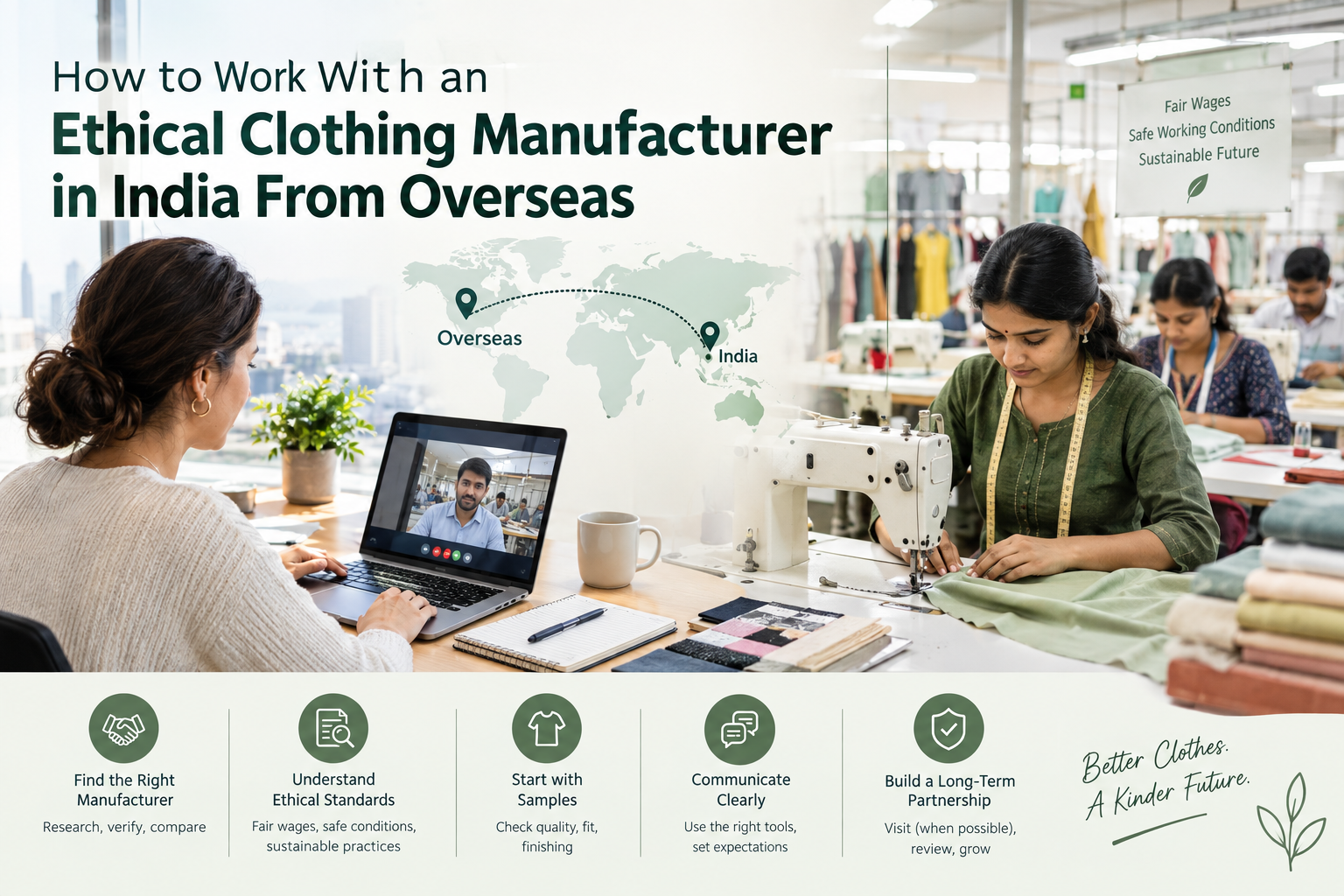
How to Work With an Ethical Clothing Manufacturer in India From Overseas
Working with an ethical clothing manufacturer in India from overseas can be a practical way for fashion brands, retailers, private-label businesses, and apparel companies to develop products with specialized manufacturing capabilities while maintaining clear standards for quality, production, and responsible sourcing. India has a large and diverse textile and apparel manufacturing ecosystem, covering cotton, organic and natural fibers, knitwear, woven garments, activewear, casualwear, resortwear, and many other categories. However, choosing a manufacturing partner from another country requires more than comparing product prices. Overseas buyers need to understand the manufacturer’s production capabilities, communication process, sampling system, certifications, material sourcing, quality control, minimum order quantities, lead times, packaging, shipping, and compliance requirements before entering into a long-term business relationship. For international brands, the right manufacturing partner should be able to translate a product concept into a commercially viable garment while maintaining agreed specifications throughout production. This becomes particularly important when working with an Ethical Clothing Manufacturer in India, because responsible manufacturing involves more than using a particular fabric or adding a sustainability claim to a product description. Buyers should look at how materials are sourced, how workers are treated, how production standards are managed, how suppliers are evaluated, and whether the manufacturer can provide appropriate documentation for its claims. Echo Earth works with apparel requirements for international markets and can be considered by overseas businesses looking for an India-based clothing manufacturing partner for private-label, OEM, ODM, sampling, production, and related apparel requirements. Understand What Ethical Clothing Manufacturing Means Before choosing an Ethical Clothing Manufacturer in India, overseas buyers should first define what ethical manufacturing means for their brand. Ethical clothing production can involve several interconnected areas, including responsible labor practices, workplace safety, transparent sourcing, appropriate wages and working conditions, environmental management, material traceability, responsible chemical use, waste management, and compliance with applicable standards. The term “ethical” should therefore not be treated as a generic marketing label. A responsible buyer should ask specific questions about manufacturing facilities, workforce practices, material suppliers, certifications, audits, production processes, and documentation. Different brands may also have different priorities. One brand may focus heavily on organic materials, while another may prioritize worker welfare, factory transparency, lower-impact production processes, or responsible packaging. Having clearly defined ethical requirements before approaching a manufacturer makes supplier evaluation much easier. It also helps prevent misunderstandings when discussing product specifications and manufacturing expectations. Define Your Product Before Contacting a Manufacturer Overseas communication becomes significantly easier when your apparel requirements are documented before contacting potential suppliers. A manufacturer needs sufficient information to understand what you want to produce and provide a realistic quotation. Prepare details such as garment category, fabric composition, fabric weight, colors, sizes, measurements, construction details, trims, labels, embroidery or printing, packaging, estimated order quantity, and target market. If you have technical packs, tech drawings, measurement charts, reference samples, or design files, these can make the development process more precise. For example, an overseas brand looking for activewear may require stretch fabrics, specific GSM, moisture-management characteristics, flat seams, custom labels, and specialized finishing. A brand developing casual shirts may have completely different requirements concerning fabric construction, buttons, collars, stitching, and washing. The more clearly these requirements are communicated, the easier it becomes for the manufacturer to understand the project. Research the Manufacturer’s Export Experience When you are located in the USA, UK, Australia, or another overseas market, international manufacturing experience matters. Working with an export-oriented supplier can make communication around documentation, packaging, shipping, customs, and international quality requirements more straightforward. If you are searching for a Clothing Manufacturer in India for USA, ask whether the manufacturer has experience supplying apparel to international buyers and whether it understands the documentation and commercial requirements associated with exports to the United States. Similarly, businesses searching for a Clothing Manufacturer in India for UK should discuss UK-specific labeling, packaging, product information, and import requirements applicable to their products. Australian brands can take a similar approach when evaluating a Clothing Manufacturer in India for Australia. Instead of assuming that every manufacturer can handle international orders in the same way, ask about previous export experience, shipping processes, documentation, and communication procedures. This does not mean that a manufacturer must have previously supplied your exact country to be capable of working with you. Rather, export experience can provide useful evidence that the supplier understands the practical requirements of international business. Ask for Factory and Manufacturing Information Before moving forward, overseas buyers should understand where their garments will actually be produced. Ask whether manufacturing is performed in the company’s own facility, through approved partner factories, or through a combination of facilities. Factory information can be especially important for brands that have defined ethical sourcing policies. Depending on your requirements, you may want to understand the facility’s workforce, production capacity, quality-control system, safety procedures, certifications, and audit history. A professional manufacturer should be able to explain its production structure clearly. If a product involves specialized processes such as dyeing, printing, embroidery, garment washing, or finishing, ask whether these processes are performed internally or by specialized suppliers. Supply-chain transparency is useful because it allows brands to understand where different stages of their product development and production take place. Verify Certifications and Ethical Claims Certifications can provide useful information, but overseas buyers should understand exactly what a certification covers before treating it as proof of overall ethical performance. Different certifications address different parts of the apparel supply chain. For example, a certification may relate to organic fibers, recycled materials, chemical management, social compliance, factory standards, or chain-of-custody requirements. Therefore, if a manufacturer presents a certification, ask for the relevant documentation and verify whether it applies to the specific facility, material, product, or production process involved in your order. For brands searching for the Best Clothing Manufacturer in India for USA, certification should be considered alongside manufacturing experience, product quality, communication, and quality-control processes. A certificate alone does not determine whether a manufacturer is the right fit for a particular apparel project. The same principle applies to businesses looking for a Top Clothing Manufacturer
